DiceRoll Academy guides
What is a virtual tabletop? A plain-language VTT guide
A practical definition of virtual tabletops, the jobs they perform and the trade-offs that matter when choosing one.
Direct answer
A virtual tabletop (VTT) is shared software for running tabletop role-playing games online or with digital assistance. It usually combines a map or scene, tokens, dice, character information and synchronized game state. A VTT supports the table; it does not replace the game master, group agreement or a reliable communication channel.
Original DiceRoll evidence
DiceRoll product evidence: one campaign, several surfaces
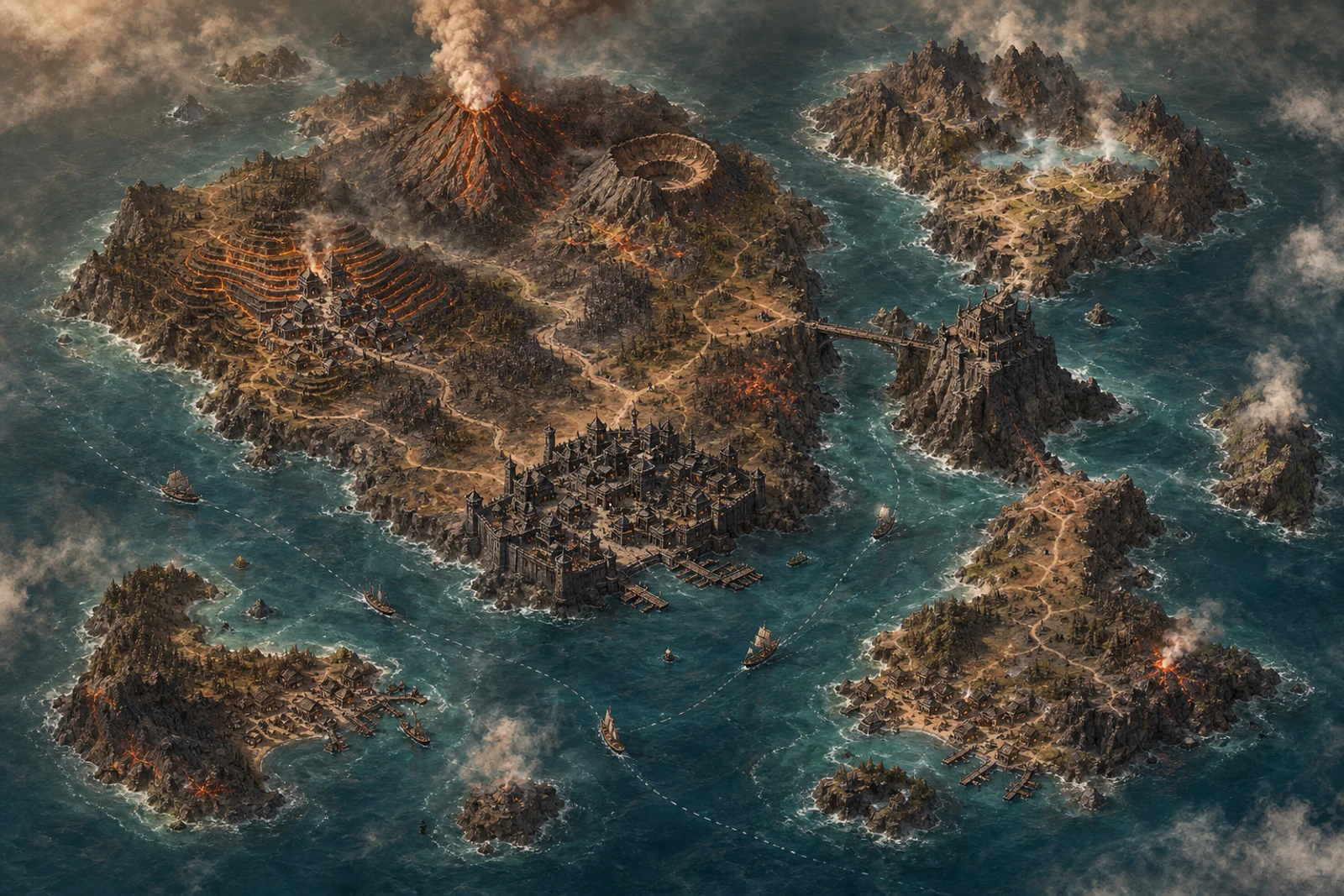
DiceRoll separates persistent campaign context from the active map. Our walkthrough covered group discovery, scheduling, characters, room data, the live canvas, journals and reusable creator content rather than treating the canvas as the entire product.
Method: Feature-boundary review of public and authenticated DiceRoll workflows, reviewed on 28 August 2026.
- The map is a synchronized scene, while the campaign persists across maps and sessions.
- Players and game masters need different permissions even when they view the same scene.
- Preparation, live play and post-session records are distinct workflows and should be evaluated separately.
The five jobs a VTT commonly performs
Most VTTs provide some combination of a shared visual surface, movable tokens, random resolution, character or rules data, and synchronized state. Some also include voice, scheduling, content stores, automation or campaign notes. A product can still be a useful VTT without every item on that list.
The important question is not how many features exist. It is whether the group can understand what is shared, what is private, who may change it and what survives after the session.
- Shared scenes or maps
- Tokens and permissions
- Dice and visible outcomes
- Character and rules context
- Persistent campaign state
What a VTT does not replace
A VTT does not decide what kind of game the group wants, resolve mismatched expectations or guarantee good pacing. Automation can enforce selected mechanics, but the group still decides how rules are interpreted and when the fiction moves forward.
It also does not remove the need for communication resilience. If the map is perfect but nobody can hear each other, the session stops. Treat voice, text and accessibility needs as first-class parts of the setup.
Evaluate a VTT with one real scene
Create the smallest scene that resembles your actual game. Invite a player, assign a character or token, make one roll, reveal information and reconnect once. Measure how long that takes and note where the player needs instructions. This test is more useful than comparing feature matrices in isolation.
Repeat the test on the slowest device and network the group expects to use. Check keyboard and touch access, readable labels, motion settings and whether the session can continue when an optional effect is disabled.
Where DiceRoll places the VTT boundary
DiceRoll treats the virtual table as part of a wider tabletop RPG platform. A campaign room holds maps, members, characters, chat, notes and session state; community and creator workflows exist outside that room. This model suits groups that want continuity around play, not only a disposable map link.
That breadth is not automatically the best fit. A group wanting only a lightweight shared sketch may prefer a narrower tool. A group needing self-hosting or a highly system-specific automation ecosystem should include those requirements in its comparison before migrating.